Factory-Direct Shipping NationwideLive UPS & Freight Rates at CheckoutNet Terms & Purchase Orders for Business AccountsReal Material Handling Experts — Premier Handling Solutions
Shop by Department
The Best Scissor Lift Tables in 2026: Manual vs Electric
Six lift tables from a $917 manual cart to a 4,000-lb electric — with a duty-cycle calculator that tells you when electric pays for itself.
By MaterialHandling.com Product Specialists • Published September 23, 2026 • Updated September 23, 2026
Prices and stock on this page are pulled live from our
inventory system — they reflect what you'd pay right now.
How we chose these picks
We picked across the three tool families buyers conflate — mobile scissor carts, stationary manual/spring tables, and stationary electric-hydraulic tables — because the right one depends on duty cycle, not budget. Selection inputs: manufacturer-published capacity, platform size, lift range and travel-time specs from our product database, our own sales data (the 4,000-lb electric pick is a top-100 best-seller in our catalog), and the duty-cycle arithmetic in the calculator above. Multi-brand list (Vestil, Eoslift); no placement is paid, and availability badges are live.
Lift tables solve the most expensive ergonomic problem in a plant: workers bending to load level. Get the work surface to waist height and injuries, fatigue and cycle times all drop. The market splits three ways — mobile scissor carts you pump up and roll, stationary manual tables (including clever spring tables that self-level as weight changes), and electric-hydraulic tables that lift tons at the push of a button.
The deciding spec is duty cycle. Pumping a manual table 5 times a day is free exercise; pumping it 50 times a day is a hidden labor cost the calculator above makes visible. Prices and stock are live.
Manual vs. electric: what does pumping cost you?
Electric tables in this guide lift a full stroke in 22 seconds (manufacturer-published travel time for our top pick). A manual foot-pump table under load typically takes 60–90 seconds of pumping — we use 75 s as the estimate. Enter your duty cycle to see the labor time at stake. Time figures are estimates for comparison, not a guarantee.
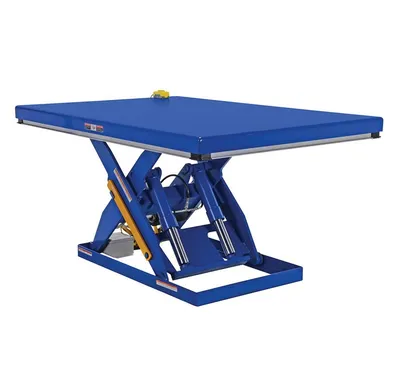
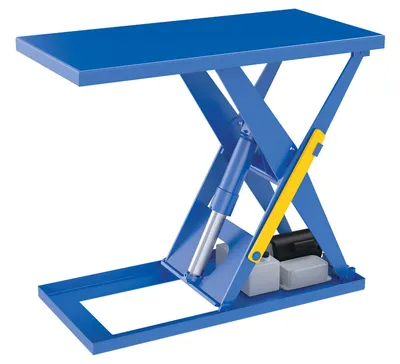
1. Vestil EHLT-4872-4-43 ELECTRIC HYDRAULIC LIFT TABLE 4K 48X72
by Vestil — Model EHLT-4872-4-43
Best for: pallet-scale loads and daily production use
The Vestil EHLT-4872-4-43 is a top-100 best-seller in our entire catalog for a reason: 4,000-lb capacity on a full 48-3/8 x 72-3/8 in. platform — a complete pallet with overhang room — lifting 36 in. in a 22-second stroke from a 2 HP power unit. Lowered height is 7 in.; raised is 43 in., right at working height. It runs 460V three-phase with a 24V push-button pendant, and it's QuickShip-eligible. One-year parts warranty.
Pros
4,000 lbs on a true pallet-size platform
22-second full lift, push-button pendant control
Proven seller — top-100 in our catalog, QuickShip-eligible
Cons
460V three-phase — confirm your electrical service first
7 in. lowered height still needs a ramp or pit for pallet-jack loading
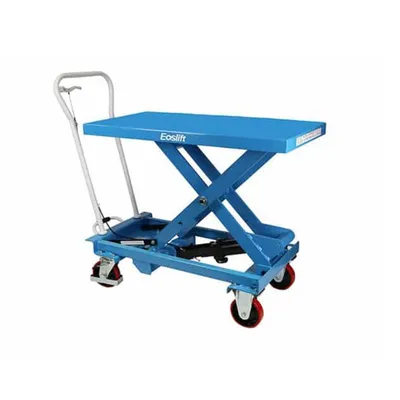
2. Eoslift USA Heavy Duty Industrial Grade TA50 Scissor Life Table Cart
by Eoslift — Model TA50
Best for: occasional lifting and positioning at low cost
The Eoslift TA50 is the entry point that doesn't feel entry-level: 1,100-lb capacity — the highest of the manual carts here — with a foot-pump scissor lifting a 27.6 x 17.7 in. steel table from 17 to 39.4 in. Electrostatic-painted steel build. For a few lifts a day at under $1,000 it's the sensible buy; the calculator above tells you when it stops being one.
Pros
1,100 lb capacity at the lowest price in this guide
39.4 in. max height reaches workbench level
Simple hydraulics — nothing to wire, little to maintain
Cons
Compact table suits boxes and parts, not pallets
Foot-pumping 20+ times a day gets old — see the calculator
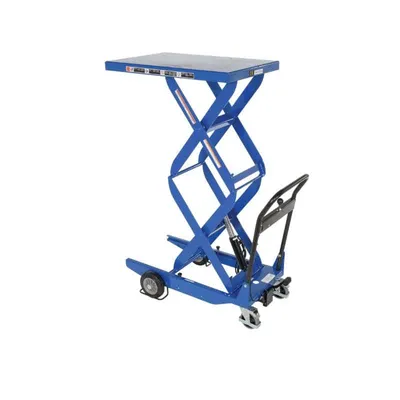
3. Vestil CART-400-D-HR Steel Double Scissor Cart with Hand Release
by Vestil — Model CART-400-D-HR
Best for: feeding machines and moving work between stations
The Vestil CART-400-D-HR uses a double scissor to reach 65 in. — presentation height for machine feeding — from an 18-1/8 in. lowered height, with a hand-release valve for controlled descent. 400-lb capacity on a 23-5/8 x 35-7/16 in. platform, 8-in. front casters that roll loaded over dock plates and floor seams. QuickShip-eligible with a one-year parts warranty.
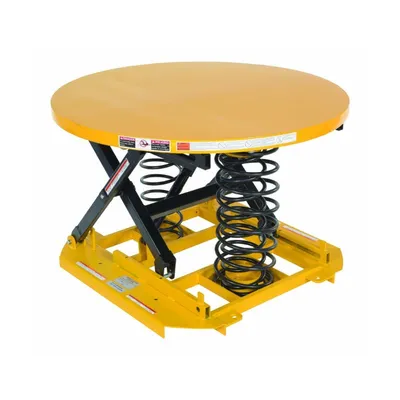
4. Vestil SST-45-ST Steel Top Spring Scissor Table 4500 Lb. Capacity
by Vestil — Model SST-45-ST
Best for: pallet loading and unloading by hand, all day
The Vestil SST-45-ST is the no-power ergonomic play: springs under the 43-5/8 in. square steel top compress as weight is added, so the working surface stays near waist height through an entire pallet build or teardown — no pumping, no electricity, no operator action at all. Rated 4,500 lbs. Workers hand-stacking pallets all shift are exactly who this exists for. QuickShip-eligible, one-year parts warranty.
Pros
Self-levels continuously with zero power or pumping
4,500 lb rating — highest capacity in this guide
Nothing to wire, plumb or maintain beyond the springs
Cons
Spring rate targets a load range — match it to your typical pallet weight
Doesn't lift on command; it's a leveler, not a lifter
5. Vestil Steel Economical Electric Hydraulic Lift Table 24 In. x 48 In. 2000 Lb. Capacity Blue
by Vestil — Model EHLT-E-2448-2-41
Best for: getting push-button lifting on a tighter budget
Vestil's 'economical' line electric table: 2,000 lbs on a 24 x 48 in. platform with a 41-in. raised height, US-made, one-year parts warranty. It's the least expensive path to powered lifting in this guide — the honest trade-off is the factory lead time, which runs around 70 days on current manufacturer scheduling (the live badge below reflects today's status). Order ahead of the need, not at it.
Pros
Electric lifting at hundreds less than comparable tables
2,000 lb capacity covers most workstation loads
US-made with a 1-year parts warranty
Cons
~70-day factory lead time — plan the purchase early
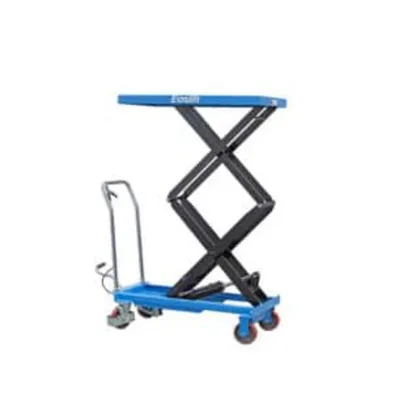
The Eoslift TAD35 stacks two scissor mechanisms to reach 62.4 in. from a 17.1-in. lowered height — nearly the reach of our Vestil positioner pick with a longer 39.8 x 20.5 in. table and a 770-lb rating that nearly doubles its capacity. Electrostatic-painted steel. If your loads run 400–750 lbs and need to arrive at counter-to-shoulder height, this is the value pick of the mobile carts.
Pros
770 lbs at 62.4 in. — best capacity-at-height of the carts
Longer 39.8 in. table takes bulkier work
Undercuts the comparable Vestil cart on price
Cons
No hand-release descent valve like the Vestil cart
Mobile carts (our Eoslift and Vestil cart picks) move the load and position it — think die changes, machine feeding, transporting work between stations. Spring tables are the no-power ergonomic trick: springs compress as you stack weight on, so the top of the load stays at working height through a whole pallet build — zero pumping, zero wiring. Electric tables win whenever cycles are frequent or loads are heavy; mind two specs buyers miss — lowered height (can a pallet jack load it, or do you need a pit or ramp?) and power supply (our top pick runs 460V three-phase; confirm your panel before ordering). Electric tables ship freight and some build to order — check the live lead-time badges.
Frequently Asked Questions
What's the real difference between a lift table and a scissor cart?
A scissor cart is a lift table on casters — it transports and positions smaller loads (usually 400-1,500 lbs). A stationary lift table bolts or sits in one spot and handles heavier loads with bigger platforms. If the load arrives by pallet jack or forklift and stays put while worked on, you want a stationary table.
How does a spring lift table level itself without power?
Calibrated springs under the platform compress in proportion to the weight on top. As a worker stacks boxes onto a pallet, the platform sinks so the top layer stays near waist height; as another worker unloads it, the platform rises. No pump, no motor, no operator input — but the spring rate targets a weight range, so match the model to your typical load.
What should I check before buying an electric lift table?
Three things: power supply (many industrial tables — including our top pick — are 460V three-phase; single-phase models exist but confirm what your panel delivers), lowered height (a 7-in. lowered height still needs a ramp or pit for pallet-jack loading), and duty cycle (motor and hydraulics are sized for intermittent use — tell us your cycles per hour and we'll confirm fit).
Are lift tables an OSHA requirement?
No rule says 'buy a lift table,' but OSHA's general duty clause covers ergonomic hazards, and lifting/bending injuries are among the most common recordables in warehousing. A lift table is one of the cheapest engineering controls available — a single avoided back injury typically costs more than any table in this guide.